
River City Wellness Perspective
This PXDocs article is shared as parent education for families in Austin and nearby communities including South Austin, Buda, Circle C, Dripping Springs, and Central Texas. At River City Wellness, our team uses a nervous-system-focused lens to help families ask better questions about regulation, stress, sleep, digestion, and development.
This information does not replace medical care from your pediatrician. If your child has severe pain, fever, vomiting, blood in the stool, weight loss, dehydration, or other concerning symptoms, seek medical care promptly.
Spotting delays or differences in your child’s development can be scary and confusing for any parent. At first, you may even dismiss these early signs or heed others’ advice to “not worry about it.”
If your child is one of the 1 in 31 children recently diagnosed with Autism Spectrum Disorder, you’re not alone in wondering where to turn for substantial support. While reports of children with communication difficulties, emotional dysregulation, anxiety, and rigid or repetitive behaviors are on the rise, conventional medicine fails to address the roots of the issue.
However, not all levels of autism look the same. A level 2 autism diagnosis sits in the middle of the spectrum’s three support tiers, and it comes with questions the DSM-5 was never designed to answer: why your child landed at level 2 instead of level 1, and whether that label is permanent.
So, what is level 2 autism? In this article, we’ll walk through this specific level, its common signs, what’s actually driving it at the nervous system level, and the steps you can take to help your child reach their fullest potential. Through Neurologically-Focused Chiropractic Care, answers and support are available.
What is Autism Spectrum Disorder?
Autism Spectrum Disorder (ASD) is a complex neurological and developmental condition characterized by social communication differences, restricted interests, repetitive behaviors, and sensory processing issues. ASD reflects atypical brain and nervous system development and occurs along a spectrum, so presentations and support needs vary widely. Challenges commonly show up in social interaction, speech and nonverbal skills, sensory regulation, and motor control, often appearing early as missed milestones or developmental delays.
What Is Level 2 Autism?
Autism Spectrum Disorder covers a wide range of characteristics and challenges. To organize that range for care planning, the DSM-5 psychiatric manual divides ASD into three support levels.
A level 2 autism diagnosis falls in the middle, indicating a child requires “substantial support” for communication, social interaction, behavior, and coping skills. It is considered moderate autism, and parents frequently report struggling more as school demands and social nuances intensify. Level 2 falls between requiring support (Level 1) and requiring very substantial support (Level 3), meaning your child needs consistent, ongoing assistance throughout their day, not just occasional help.
You’ll see this same diagnosis described several different ways, and the inconsistency trips parents up. Some clinicians and websites say “autism level 2,” others write “autistic level 2” or “level 2 ASD.” You’ll also run into “stage 2 autism” and “type 2 autism,” which are common misnomers. The DSM-5 uses levels, not stages or types, because a stage implies a fixed sequence every child moves through in order. That isn’t how autism works. All of these terms point to the same thing: a child who needs substantial support across both core areas of the diagnosis.
The diagnostic process involves developmental screening followed by formal diagnostic testing, such as ADOS-2 assessments. These evaluations examine specific diagnostic criteria that designate one of the three levels of autism outlined in DSM-5.
Each child develops uniquely, though, and labels often fail to capture strengths, challenges outside core areas, fluctuating skills, and diversity in support needs. In fact, researchers reviewing the severity system have noted the levels are difficult to apply consistently, precisely because a child’s support requirements vary across settings and change over time.
DSM-5 Diagnostic Criteria for Level 2 Autism
The DSM-5-TR uses specific severity specifiers to determine autism support levels. To meet Level 2 criteria, a child must show substantial support needs in both core areas: social communication and restricted or repetitive behaviors.
In social communication, Level 2 is characterized by marked deficits in verbal and nonverbal skills. Even with supports in place, social impairments remain apparent. Children may:
- Initiate very limited social interactions
- Provide reduced or unusual responses to social overtures from others
- Speak in simple sentences, but struggle to maintain back-and-forth conversations
- Display obviously restricted nonverbal communication (limited eye contact, flat affect, difficulty reading social cues)
For restricted and repetitive behaviors, Level 2 involves inflexibility that significantly interferes with functioning across multiple contexts. The key distinction is that these behaviors are obvious to casual observers and difficult to redirect, requiring substantial intervention and support throughout the day.
Worth knowing: the two areas are rated separately. A child can be level 1 for social communication and level 2 for restricted behaviors, or the reverse. That’s why two children with the same “level 2 autistic” label can look nothing alike.
Why Does Level 2 Autism Look Different From Level 1?
Here’s the question the DSM-5 doesn’t answer. The manual tells you how much support a child needs. It doesn’t explain why one child needs a little while the next needs a lot.
In clinical practice, Dr. Tony Ebel describes what he sees on level 2 exams this way: it’s the same picture we see at level 1, but more of it and worse. Not a different condition. The same underlying nervous system dysregulation, sitting deeper and running longer.
Think of it like this. Your child’s gas pedal (Sympathetic Nervous System) got stuck down during critical developmental windows, while the brake pedal (Parasympathetic Nervous System and vagus nerve) never fully came online. At level 1, that imbalance shows up as social awkwardness, clumsiness, some anxiety, and mild sensory sensitivity. At level 2, the gas pedal has been pinned longer and harder.
And a nervous system can only run in fight-or-flight overdrive for so long before it runs out of gas. That’s the piece most parents have never had explained to them. Early on, these kids often look wired: colic as an infant, hyperactivity, impulsivity, sensory meltdowns as a toddler. Parents get told it’s the terrible twos, and they’ll grow out of it. They don’t grow out of it. They grow into deeper dysregulation, and eventually the system exhausts itself and starts to withdraw. The shutdown, the flat affect, the loss of words, the pulling away from people- that isn’t a personality. It’s an exhausted nervous system.
This is also why level 2 autism so rarely travels alone. ADHD, Sensory Processing Disorder, anxiety, sleep problems, and digestive trouble show up alongside it constantly. They’re not four separate diagnoses that happened to land on one child. They’re different surface expressions of the same autonomic dysregulation, which is measurable: children with autism show significantly lower resting heart rate variability than their neurotypical peers, and reduced cardiac parasympathetic activity has been documented repeatedly in this population.
How Is Level 2 Autism Diagnosed?
Recognizing autism early and obtaining an accurate diagnosis opens the door to support and intervention. The process typically unfolds in two phases: developmental screening and comprehensive evaluation.
Developmental Screening
Healthcare providers screen children for developmental delays and autism during routine wellness visits, typically at 18-month and 24-month checkups. The M-CHAT (Modified Checklist for Autism in Toddlers) is the most common tool: a parent-completed questionnaire with 20 yes/no questions covering behaviors such as pointing to share interest, responding to name, and making eye contact. It’s designed for 16-to-30-month-olds.
Parents play a crucial role here. You know your child best, and your observations of missed milestones, such as not pointing to share interest by 18 months or not engaging in pretend play by age 4, give providers information no checklist captures.
Comprehensive Diagnostic Evaluation
If screening suggests autism, a thorough evaluation follows. Developmental pediatricians, psychologists, or neurologists conduct detailed assessments using tools like:
- ADOS-2 (Autism Diagnostic Observation Schedule): The gold-standard assessment. Trained evaluators observe your child’s social communication, interaction patterns, and repetitive behaviors during structured, play-based activities. It takes about 40-60 minutes.
- ADI-R (Autism Diagnostic Interview-Revised): In-depth parent interview about developmental history
- Cognitive and language testing: Evaluates intellectual abilities and communication skills
The evaluation examines whether a child meets DSM-5 criteria, including persistent challenges in social communication across multiple settings and restricted, repetitive behavior patterns causing clinically significant impairment. Evaluators also work to rule out ADHD, anxiety disorders, and selective mutism as the primary explanation. These assessments then determine the support level: requiring support (Level 1), substantial support (Level 2), or very substantial support (Level 3).
The Missing Piece
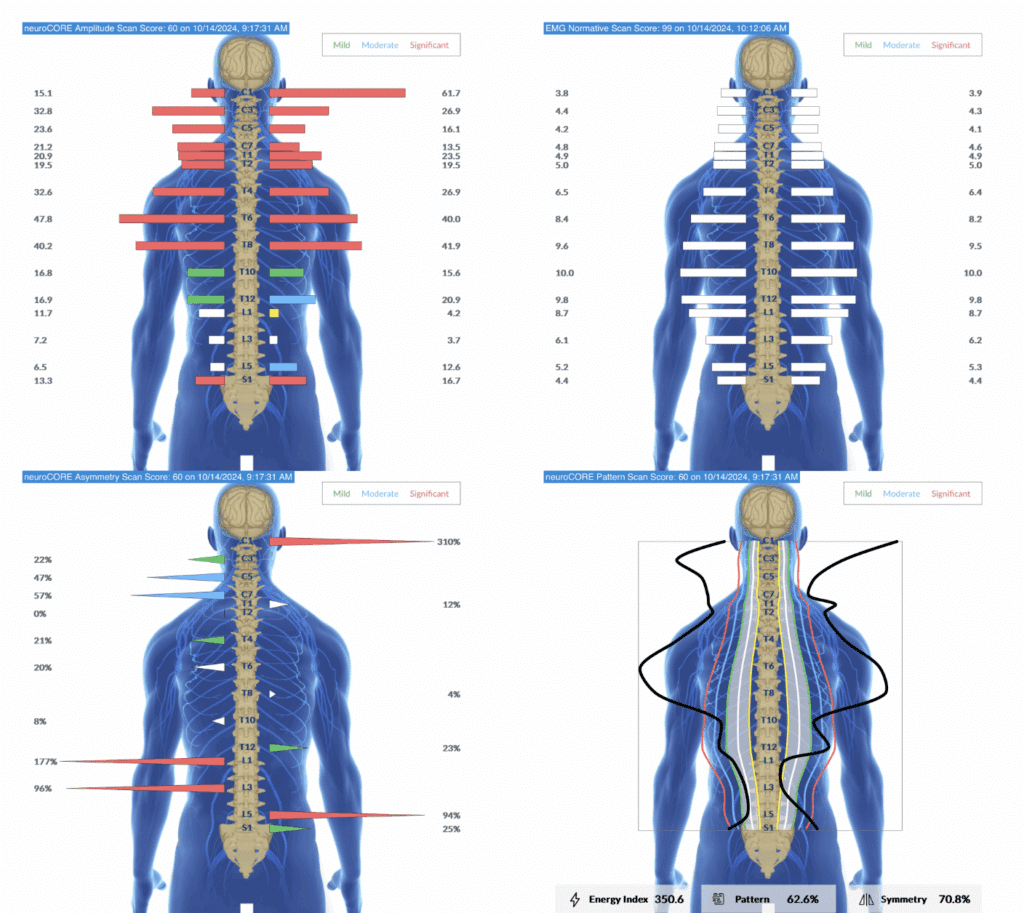
While these assessments identify behavioral traits, they often miss the underlying neurological dysfunction. At PX Docs, we use INSiGHT neurological scans to detect subluxation, a combination of misalignment, fixation, and neurological interference in the neurospinal system, along with the nervous system stress that conventional testing overlooks.
What that scan picture typically looks like at level 2 is worth describing, because it’s specific. Thermal and sEMG scans show significant tension, asymmetry, and neuroinflammation, most often concentrated through the neck, shoulders, and jaw, with corresponding weakness elsewhere. Heart rate variability readings show sympathetic dominance paired with depleted vagal tone. In other words, the scans capture both halves of the story: a system wound tight and a system running on empty. That combination shapes how care gets sequenced, and it’s information no behavioral checklist provides.
How Level 2 Autism Compares to Levels 1 and 3
The three-level system helps families and providers understand the degree of support a child needs.
Level 1, requiring support: These children often function in mainstream settings with some accommodations. They may struggle to initiate social interactions and switch between activities, but challenges are less pronounced. Note that level 2 is not “high-functioning autism,” a term that maps loosely onto level 1.
Level 2, requiring substantial support: More noticeable difficulty with social communication. Short sentences, trouble sustaining conversation, unexpected responses in social situations. Restricted interests and repetitive behaviors are obvious to casual observers, and routine changes cause marked distress.
Level 3, requiring very substantial support: Minimally verbal or nonverbal, with severe social communication deficits. Repetitive behaviors interfere across all areas, and support needs are intensive and ongoing.
Autism Is Not a Static Place
Here’s something most families never get told: support levels aren’t permanent labels.
The research is fairly direct on this. A longitudinal study of autism symptom trajectories found that roughly 30% of children showed less severe symptoms at age 6 than at age 3, with some losing their diagnosis entirely. A later review of the same question concluded that a person’s autism presentation is not constant across the lifespan, and that severity moves in both directions, with a meaningful subgroup increasing over time.
The second half matters as much as the first. Movement is possible. So is drift. A child whose dysregulation goes unaddressed can slide toward a more severe presentation, which is exactly the exhaustion pattern described earlier. Autism is not a static place. It’s a trajectory, and trajectories can be influenced.
Regardless of support level, the underlying issue often remains nervous system dysfunction. Our approach addresses that root rather than simply managing the behavioral traits that define each level.
Common Traits in Level 2 Autism
Every child with ASD is unique, but level 2 has defining features that make daily life markedly challenging without substantial support.
Communication Challenges
- Limited verbal ability, often short phrases or simple sentences
- Poor back-and-forth conversational ability; may speak mostly about special interests
- Difficulty initiating communication
- Echolalia, scripting, or repetitive speech patterns
Social Interaction Issues
- Struggles to read social cues, including facial expressions and body language
- Difficulty initiating social interactions, even when the desire to connect is present
- Limited emotional reciprocity and interest in peer relationships, often alongside speech delays
- Prefers solitary play; problems making age-appropriate friends
Behavioral and Emotional Dysregulation
- Trouble identifying one’s own and others’ emotions
- Extreme reactions to changes in routine
- Frequent tantrums and emotional meltdowns
- Aggressive or self-injurious behaviors
Cognitive Rigidity and Repetitiveness
- Insistence on sameness and rituals
- Intense fixation on special interests or topics
- Repetitive motor mannerisms
- Difficulty with transitions or shifting focus
Motor Tone and Coordination Challenges
This one gets overlooked constantly, and at level 2 it’s often significant. A systematic review found a consistent association between early muscle hypotonia and autism, enough that researchers have proposed low tone as a potential early marker for later diagnosis.
Parents notice it as clumsiness, poor posture, fatigue during physical play, messy handwriting, or a child who slumps in a classroom chair. What they don’t usually hear is the mechanism. In clinical practice, Dr. Tony Ebel points out that low muscle tone usually isn’t a strength problem at all. It commonly coexists with hypertonicity: some muscles locked in tension, often through the traps, shoulders, and jaw, while others sit exhausted and underused. The floppiness is downstream of tension held elsewhere in the neurospinal system. That’s why simply strengthening the weak muscles often stalls out. Address the tension driving the pattern, and the tone tends to organize itself.
Parents may also notice sensory processing sensitivities, sleep issues, teeth grinding, and chronic health problems like gastrointestinal distress, reflux, constipation, eczema, and frequent illness.
What Causes Level 2 Autism
While genetics may confer a vulnerability to autism, research now recognizes that a cascade of environmental triggers can also compromise an immature nervous system. We refer to that cascade, which alters neural connectivity and disrupts healthy nervous system maturation, as “The Perfect Storm™.”
Some of these environmental triggers include:
Prenatal Maternal Stress and Infection
- Stress hormones and inflammation impact fetal brain development
- Alters neuroendocrine systems closely tied to ASD risk
Birth Trauma
- Interventions like C-sections, induction, and vacuum or forceps extraction can injure delicate nerve pathways, resulting in birth trauma
- Cranial disturbances and neurospinal tension patterns affect brain-body communication
Frequent Antibiotics and Ear Infections
- Disrupting healthy gut flora essential for immune function and neurotransmitters
- Gut-brain axis issues create downstream effects
Toxins, Poor Diet, and Sleep Disruption
- Chemical exposures trigger oxidative stress and inflammation
- Nutrient deficiencies and sleep issues also alter brain function
This cumulative burden taxes growing bodies and minds, sparking a neurological “brain fire” marked by sensory overload, behavioral struggles, and developmental delays. These stressors don’t just contribute to autism; they help determine how severe the presentation becomes.
One more thing worth naming: where this dysregulation gets held. It isn’t only a gut or brain conversation. It lodges in the physical body first, in the sensory motor system, which is why birth trauma, posture, and gross motor delays matter so much here.
Restoring Nervous System Order Beyond Medication
Mainstream medicine often takes a cookie-cutter approach to level 2 autism: label the observable behavioral traits, prescribe psychiatric medications to “manage” the signs, and recommend standard therapies that work around rather than resolve the underlying issues.
While this offers some short-term relief, it doesn’t address the true neurological origins of the sensory, social, speech, and coordination challenges these children face. Research links autism with neurological dysfunction, calling for a more Neurologically-Focused care plan to reignite key neural networks.
It’s important to note that INSiGHT scanning technology doesn’t diagnose medical conditions, and Neurologically-Focused Chiropractic Care isn’t a treatment or cure for level 2 autism or any other condition, not even back pain. Instead, these INSiGHT Scans help us identify the root cause of nervous system dysfunction and dysregulation, and build customized care plans to help shift your child’s system back into balance, regulation, and resilience.
To help children reach their potential, it’s essential to address roots like:
- Cranial disturbances and tension patterns affecting brain-body communication
- Dysautonomia marked by sympathetic overload and vagus nerve suppression
- Neuroinflammation, immune disturbances, and neurotransmitter imbalances
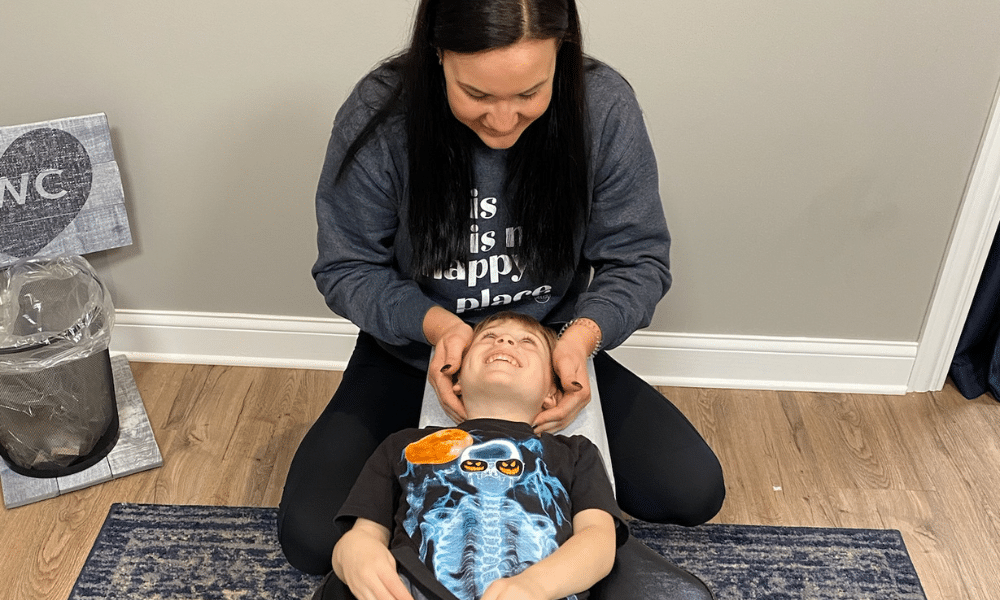
Where traditional chiropractic focuses on pain relief and mobility, Neurologically-Focused Chiropractic Care brings deeper neurological assessment and precision to the neurospinal system. Gentle “Neuro-Tonal” adjustments are tailored to each child, reducing sympathetic tension and stimulating vagal tone.
What changes first is rarely what parents expect. Before speech or social skills shift, we look for what we call neurological soft signs: falling asleep faster and staying asleep, more regular digestion, better motor planning, easier transitions. Those are the early markers that the nervous system is reorganizing. As that regulation builds, many parents report improvements in sensory processing, behavioral regulation, focus, and digestive function.
Early Intervention and Evidence-Based Therapies
The earlier autism is identified and addressed, the better. Research shows that early intervention before age 3, during critical windows of neural plasticity, leads to significantly better long-term developmental outcomes.
Common evidence-based interventions include Applied Behavior Analysis (ABA) for skill-building through positive reinforcement, speech therapy for communication and nonverbal cues, occupational therapy for daily living skills and sensory processing, and physical therapy for gross motor skills and coordination.
These therapies provide essential skill-building and belong in a comprehensive support plan. They work from the outside in, teaching the brain new behaviors. Neurologically-Focused Chiropractic Care works inside-out, reducing interference so the nervous system can receive and integrate what those therapies are teaching.
Sequence matters more than most families are told. When a child is struggling this much, the instinct is to start everything at once: ABA, speech, OT, diet changes, supplements, detox protocols. Dr. Tony Ebel compares healing a dysregulated nervous system to a combination lock rather than a key. The dials have to turn in the right order. Loading a dozen interventions onto an already overwhelmed system tends to overwhelm it further, which is why so many families report doing all the right things with disappointingly little to show for it. Establish foundational regulation first, then layer the rest on top. The same interventions often work better in that order.
Even if your child has already been diagnosed with level 2 autism, it’s never too late to address nervous system dysregulation at its roots.
Can Level 2 Autism Be Cured?
This is one of the most common questions parents ask after diagnosis, and it deserves an honest answer. No, there is no cure for autism, and Neurologically-Focused Chiropractic Care is not a treatment for it. Autism is a neurodevelopmental difference in how the brain processes information and experiences the world.
But support levels can and do change, as the research above shows. A child diagnosed at level 2 at age 3 may need only level 1 support by age 8. Some move below the clinical threshold entirely as their nervous system matures and regulates.
The goal isn’t to “cure” autism or make your child someone they’re not.
The goal is optimal nervous system function so your child can be the fullest version of themselves. We’re not fixing something broken. A nervous system that went through The Perfect Storm™ carries stress and dysregulation, and that is something we can help with. Many children gain skills, communicate more, and struggle less, not because anyone cured autism, but because their nervous system finally got to work the way it was designed to.
Supporting Your Child and Family
A diagnosis leaves most parents overwhelmed and full of questions. Know that hope and help exist, and that small, consistent steps add up.
- At home: Use visual schedules and timers, create sensory-friendly spaces for regulation, and prepare social stories that preview new experiences.
- At school: Request an individualized education plan (IEP) with accommodations tailored to your child, such as visual schedules for transitions, sensory breaks every 20-30 minutes, and preferential seating away from distractions. Partner closely with teachers and address co-occurring ADHD and sleep issues, which often improves classroom functioning more than classroom strategies alone.
- With friends and family: Explain differences in communication, play, and behavior, advocate for your child’s needs around others, and find a community that values their uniqueness.
- For yourself: Prioritize bonding through your child’s special interests, trade notes with other parents of children with special needs, and make self-care a regular commitment rather than an afterthought.
No one knows your child like you do. Trust your instincts.
Next Steps to Help Your Child Thrive
If you’re wondering where your child actually sits on this map, and whether their level 2 diagnosis is a ceiling or a starting point, the answer isn’t to guess. We don’t guess. We test.
Care begins with a baseline set of INSiGHT Scans showing where your child’s neurospinal system and autonomic balance are right now. For a level 2 kiddo, that means seeing exactly where tension is locked in and how far vagal tone has been depleted, in numbers rather than impressions.
That first scan is the beginning, not the whole picture. As care unfolds, repeat scans at regular intervals tell us whether the system is genuinely responding: heart rate variability climbing, neurological tone organizing, the soft signs holding. If the data shows we’re on track, we keep building. If it shows something isn’t moving the way it should, we change the plan rather than waiting and hoping.
That’s what keeps your child’s care anchored to what’s actually happening inside their nervous system instead of how things look on the surface. It also means you’ll never spend a year wondering whether any of this is working.
To get started, visit our PX Docs Directory to find a PX Doc near you.
Questions Austin Parents Ask
How does River City Wellness use PXDocs articles?
We share these articles as parent education. During visits, our team evaluates nervous system and spinal function to help families better understand regulation, stress, sleep, digestion, focus, and development.
Does this replace my child’s medical care?
No. This information does not replace diagnosis, treatment, or follow-up from your pediatrician or another medical professional. Seek medical care for severe, new, or worsening symptoms.
Where is River City Wellness located?
River City Wellness is located at 8708 S. Congress Ave Suite 570, Austin, TX 78745. We serve families from Austin and nearby communities including South Austin, Buda, Circle C, Dripping Springs, and Central Texas.
Originally published on PX Docs by Dr. Tony Ebel, DC, CPPFC, CCWP.
Synced to River City Wellness for educational purposes.